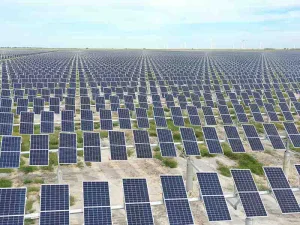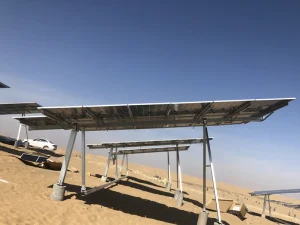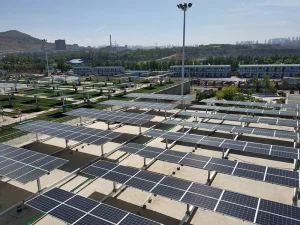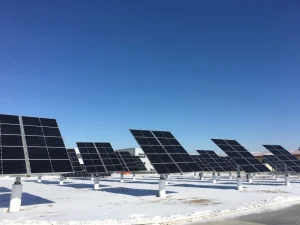
Optimized for Southern Ontario latitude to maximize yield during peak summer months.
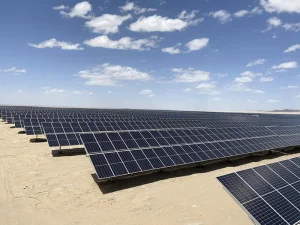
Manual seasonal adjustment capability for high-latitude efficiency gains.
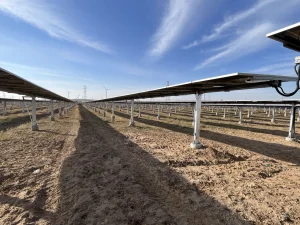
Reduced structural profile for urban integration and commercial rooftop applications.
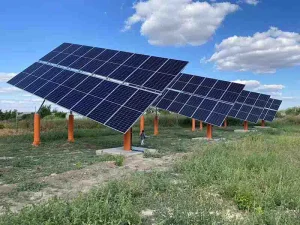
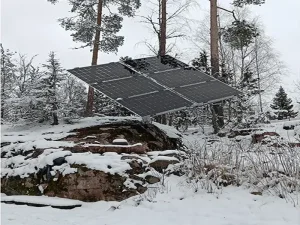
Superior energy capture in low-light winter conditions common in the GTA.
As Toronto transitions toward its TransformTO Net Zero Strategy, the demand for high-efficiency photovoltaic (PV) infrastructure has reached an all-time high. Traditional fixed-tilt racking is no longer sufficient for investors seeking the fastest possible payback periods. In the Greater Toronto Area (GTA), where seasonal sun angles vary drastically from 23.5° in winter to 70.5° in summer, Manual Adjustable Solar Racks and Active Tracking Systems have emerged as the gold standard for commercial and industrial (C&I) growth.
Globally, the solar industry is shifting from "quantity" to "quality of capture." Modern racking solutions must solve two major challenges: Geometric Misalignment and Structural Integrity. In Toronto, the geometric misalignment refers to the fixed angle losses during winter solstice. By utilizing manual adjustable PV brackets, operators can increase energy production by 15% to 25% simply by optimizing the tilt twice a year.
Shandong Zhaori New Energy Tech. Co., Ltd. provides localized solutions that account for Ontario's heavy snow loads and wind speeds that can exceed 100 km/h during lake-effect storms. Our hot-dip galvanized steel structures are engineered to exceed CSA (Canadian Standards Association) requirements.
While global markets like Arizona or Dubai focus on heat dissipation, the Toronto market requires Snow Shedding Capabilities. A manual adjustable rack allows for a "steep tilt mode" (60°+) during January and February, preventing snow accumulation that often renders flat-roof systems useless for weeks. This is "Information Gain" for EPC (Engineering, Procurement, and Construction) firms—knowing that tilt flexibility is not just about the sun, but about weather resilience.
Monthly Production
R&D Expertise
Global Patents
Navigating the Ontario Building Code (OBC) is critical for any solar installation. Our engineering team provides full documentation for:
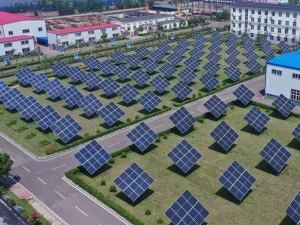
Utilizing 2P Flat Single Axis Trackers to maximize energy density on large warehouse roofs, supporting 24/7 logistics operations with green energy.
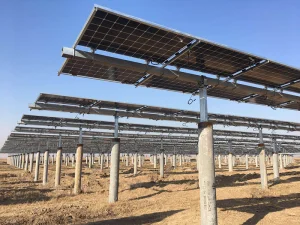
Dual-axis trackers (ZRD series) allow for simultaneous land use—farming and energy production—thanks to high-clearance mounting options.
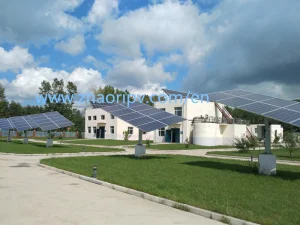
Integrating semi-auto trackers into corporate headquarters to reduce peak-shaving costs during Ontario's expensive mid-day rate periods.
Shandong Zhaori New Energy Tech. Co., Ltd. is a high-tech and new energy company based on independent intellectual property rights. Founded in June 2012, we have evolved into a global leader with 10 specialized departments, including a world-class R&D team and Quality Assurance wing. With over 60 professional technology talents, our team focuses on photovoltaic power stations and solar tracking technology for more than 10 years.
Our factory covers an area of 50,000 square meters, utilizing CNC machine tools, laser cutting, and automatic welding robots to ensure every rack meets the precision required for high-latitude Canadian installations.
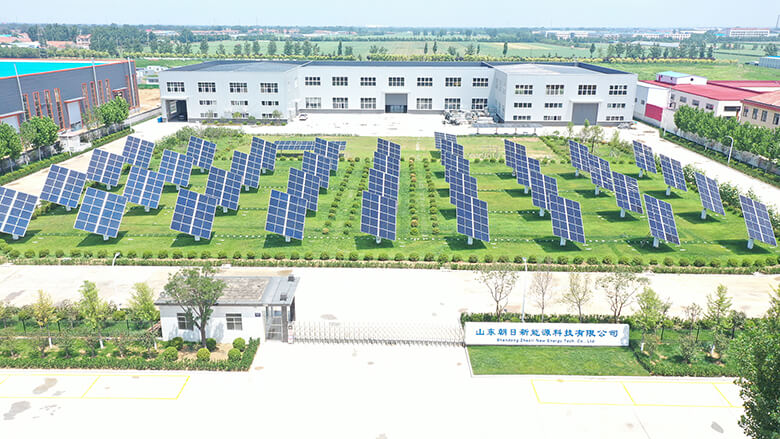
Our R&D department is currently integrating AI-Driven Predictive Tracking. In a Toronto context, this means the system can sense an incoming snowstorm via satellite data and automatically tilt modules to a vertical position to prevent accumulation. Furthermore, we are exploring Bifacial-Optimized Racking, which leverages the high albedo (reflectivity) of snow to capture energy from the backside of the panels, turning a Canadian winter into a power-generation asset.
Every ton of steel used in our racks is sourced with sustainability in mind, designed to be 100% recyclable at the end of its 30-year lifecycle. By choosing Zhaori Solar, Toronto businesses are not just buying a product; they are investing in a sustainable legacy.
Because Toronto's latitude (43.6°N) results in a massive difference in sun position between July and January. A fixed rack is usually a compromise. A manual adjustable rack allows you to optimize for both seasons, increasing yield by up to 25% with just two adjustments per year.
Absolutely. Our ZRT and ZRD systems are designed for extreme environments. We use heavy-duty materials that are tested for high snow loads and freezing rain conditions. The "Snow Mode" functionality is a key feature of our automated tracking systems.
With the current energy prices and federal tax incentives (such as the Clean Technology Investment Tax Credit), most Toronto businesses see an ROI within 5 to 7 years, significantly faster than traditional fixed systems.
We work with a network of local EPC partners across Ontario to provide full turnkey solutions, from structural engineering stamps to final interconnection with the grid.
 Zhaori